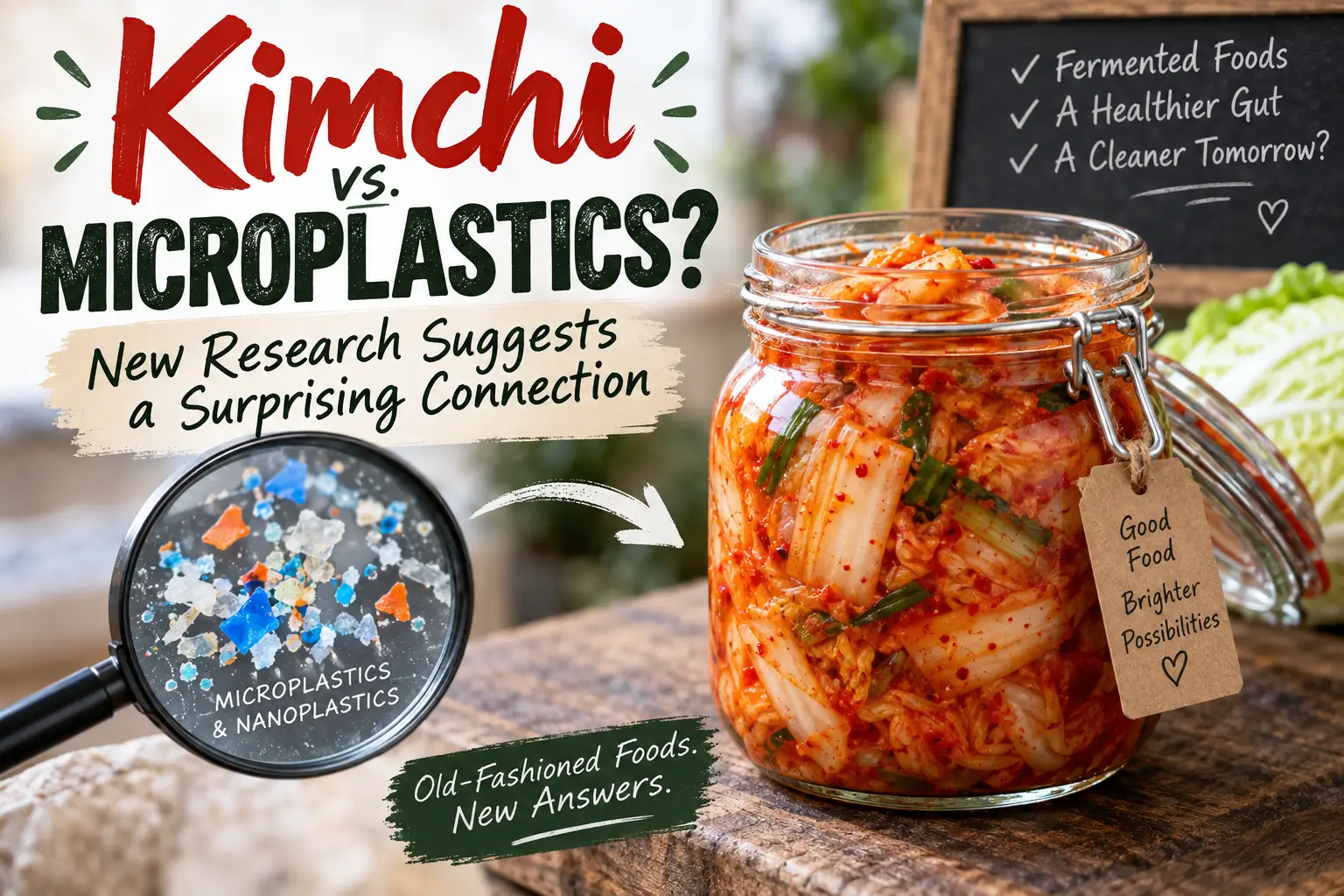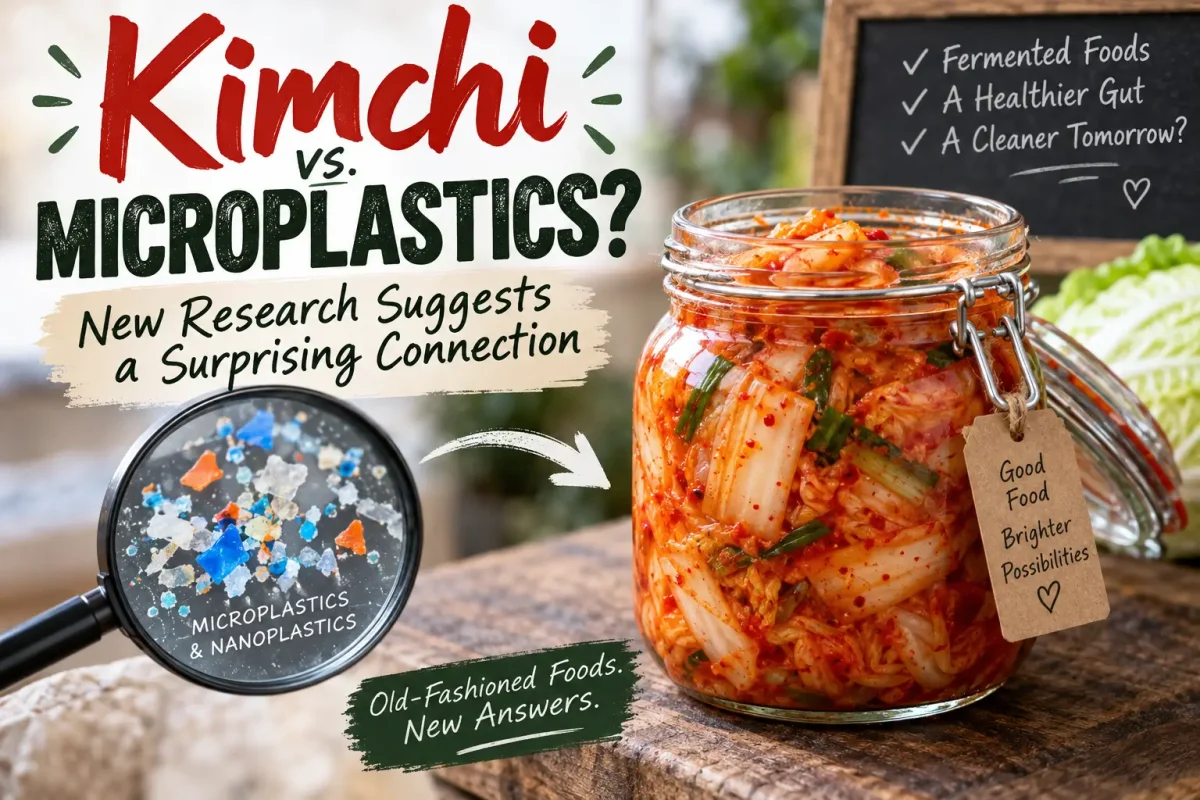
Kimchi vs. Microplastics? This New Research Got My Attention
Just when you thought fermented cabbage couldn't get any more interesting…
Scientists have discovered that a bacterium found in kimchi may help the digestive system get rid of tiny plastic particles.
Yep.
Apparently, we're eating plastic now, and fermented cabbage might have something to say about it.
Welcome to 2026.
First…We're Eating Plastic?
Unfortunately, tiny pieces of plastic—called microplastics and nanoplastics—have become widespread in our environment.
They're found in food, water and even the air around us.
Scientists are still trying to understand exactly what long-term exposure means for our health. But naturally, one big question is:
Can we help the body get rid of them?
That's where kimchi comes into the story.
Scientists Found an Interesting Bacterium in Kimchi
Researchers studying bacteria isolated from kimchi found one strain that caught their attention.
It's called:
Leuconostoc mesenteroides CBA3656.
Try saying that three times fast.
I'll just call it the kimchi bacteria.
Researchers discovered that this bacterium could attach itself to extremely small pieces of polystyrene called nanoplastics.
In laboratory testing, researchers reported an adsorption efficiency of approximately 87 percent under standard conditions.
Even more interesting, the bacteria continued binding to the plastic particles when researchers placed them in simulated intestinal fluid.
That's important because if something is going to work inside the digestive system, it needs to survive conditions somewhat similar to the digestive system.
Then Came the Mice
Of course, scientists weren't going to stop with a petri dish.
Researchers tested the bacterium in germ-free mice exposed to nanoplastics.
The mice receiving the kimchi-derived bacteria eliminated significantly more nanoplastic particles through their poop than the control group.
Yes.
Scientists studied mouse poop so we could learn whether fermented-food bacteria might help us get rid of plastic.
Science can be glamorous.
How Does It Work?
Researchers believe the surface of these bacteria can physically interact with the plastic particles.
Basically, the tiny plastic particles stick to the bacteria.
The technical term is biosorption.
The idea researchers are investigating is pretty simple:
Bacteria grab plastic → plastic stays in the digestive tract → plastic leaves with the poop.
At least that's what the animal research suggests.
And honestly, if plastic has gotten into my digestive system, that's exactly where I'd like it to go.
Does This Mean Eating Kimchi Will Detox Your Body?
Not so fast.
This is the really important part.
The study did NOT prove that eating kimchi removes microplastics from humans.
Researchers isolated a particular bacterial strain from kimchi and studied its ability to bind nanoplastics. The experiments involved laboratory conditions and mice—not people sitting down and eating bowls of kimchi.
So we're not at the point where anyone should claim:
“Eat kimchi and detox your body from microplastics!”
That's getting way ahead of the science.
Human studies are still needed.
But This Isn't the Only Interesting Research
Other scientists are investigating whether probiotic bacteria might interact with microplastics in similar ways.
Another study screened hundreds of bacterial strains and found particular probiotic strains capable of binding microplastics. Animal testing suggested the probiotics could increase plastic excretion while reducing the amount remaining in the intestines.
That raises a fascinating possibility.
Maybe some of the microorganisms living in—or passing through—our digestive systems could eventually become part of the solution to our growing microplastic problem.
We simply don't know yet.
Another Reason I'm Fascinated by Fermented Foods
This is one reason I love learning about old-fashioned food preservation.
Humans have been fermenting food for thousands of years.
Kimchi.
Sauerkraut.
Pickles.
Yogurt.
Kefir.
People didn't know anything about microbiomes, probiotics or microscopic plastic particles.
They just knew fermentation helped preserve food—and that fermented food was good to eat.
Now researchers are discovering just how complicated those little microorganisms really are.
Should You Start Eating Kimchi?
If you already enjoy kimchi, this research certainly gives you something interesting to think about.
But don't start eating a gallon of kimchi every day because somebody on the internet told you it'll clean plastic out of your body.
That's not what the research proved.
Not all kimchi contains exactly the same microorganisms, either. Different ingredients, fermentation methods and storage conditions can change the bacterial community.
The researchers studied one specific strain isolated from kimchi.
There's a big difference between that and saying every jar of kimchi sitting in the grocery store will produce the same result.
The Bottom Line
Do we know that eating kimchi removes microplastics from people?
No.
Did researchers discover a bacterium from kimchi that can bind nanoplastics and help mice eliminate more of those particles?
Yes.
And that's interesting enough all by itself.
Researchers now have another avenue to explore as they investigate ways to reduce our exposure to—and possibly help our bodies eliminate—tiny plastic particles.
Meanwhile, I'm going to keep fermenting food.
Because every time science takes another look at these old-fashioned foods, we seem to discover there was a lot more going on inside that jar than we realized.
And if someday scientists discover that fermented cabbage can help us poop out plastic?
Well…
I certainly didn't have that on my bingo card.